
After Two Losses, Teen Robotics Team Wins Worlds
Twenty-one Santa Cruz County, California high schoolers just became world champions in underwater robotics - after finishing third place two years in a row. Hephaestus Robotics, part of a free STEM program open to any student, beat 47 teams from 13 countries at the 2026 MATE ROV World Cham
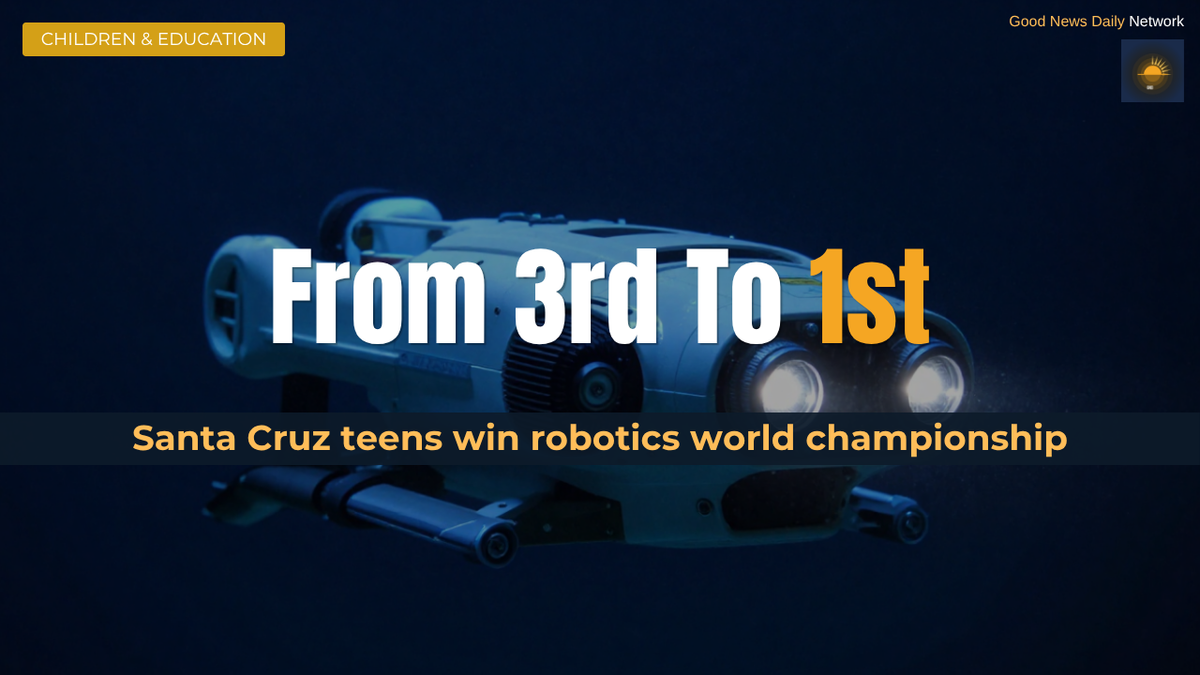
Twenty-one high schoolers from a stretch of California coastline you've probably never heard of just out-engineered teams from thirteen different countries, piloting a robot named Talos through some of the coldest water on the competition circuit.
Two years in a row, this same team climbed onto the world stage and watched someone else's name get called for first place.
Here's what makes this hard. Every year, teenagers from around the world design and build underwater robots from scratch to compete in the MATE ROV World Championship, a competition built around real ocean science and offshore engineering tasks, judged by actual industry professionals. It isn't a hobby project. Teams operate like startup companies: they build a working robot, write technical reports, manage a budget, and defend their engineering choices in front of a judging panel. In Santa Cruz County, that team is called Hephaestus Robotics, part of a free program run by the county's Office of Education and a nonprofit called X Academy, open to any student, no cost involved. This year's roster brought together, as the program's founder Tim Sylvester put it, "the children of Silicon Valley tech workers, doctors, carpenters, electricians, and farmworkers" - twenty-one students from eight different high schools, all building toward the same robot.
For nine months, they built, tested, broke, and rebuilt that machine, logging more than a hundred hours of practice in a swimming pool alone. Then they packed up their equipment and flew to St. John's, Newfoundland, the easternmost point of North America, to face eighty-six teams from sixteen countries, forty-seven of them in their own division. In a facility built to simulate real ocean currents, their robot, Talos, replaced a simulated sensor, recovered an anchor buoy, and did something only three of the forty-seven teams managed all weekend: it deployed an autonomous float that held its depth and beamed data back to the surface for a perfect score. Then came the part that wasn't simulated at all. Out in the actual Atlantic Ocean, the team piloted Talos with a real sonar tool, scanning the harbor for actual ghost fishing gear and marine debris.
When the scores were tallied, Hephaestus Robotics had earned 340 of a possible 395 points and took first place in the Ranger Class. The program's first world title, after finishing third two years running.
What gets me about this story isn't just the trophy. It's that a free after-school program in one California county just proved a kid's zip code or a parent's paycheck doesn't have to decide who gets to do real engineering. And that last mission, the one where they searched real water for real debris, is a reminder that the next generation of ocean scientists isn't waiting for college to start caring about our planet. They're already out there, sonar in hand.
Sources: pajaronian.com · santacruzworks.org
Related: shop on Amazon · shop on Amazon
Enjoy good news? Get your daily dose of sunshine free →
This post may contain affiliate links; we may earn a small commission at no cost to you. AI disclosure: our videos are produced with AI tools (ElevenLabs voice, Pictory) with human research, fact-checking, and editorial review on every story.
